
Portion control for weight loss does not have to mean tiny meals, weighing every ingredient or constantly worrying about how much you are “allowed” to eat. A more realistic approach is to learn what healthy portions can look like for you, notice your hunger cues and fullness cues, and build healthy weight habits that fit into everyday life.
Table of Contents
What Does Portion Control for Weight Loss Actually Mean?
Portion control for weight loss is better thought of as portion awareness rather than strict portion restriction.
A portion is simply the amount of food you choose to eat at one time. That amount may be different from the serving size printed on a packet, recipe or food guide.
Your ideal portion sizes can also vary from one day to another depending on your appetite, activity, routine and overall eating pattern.
This is why sustainable weight management is rarely about finding one perfect plate size and repeating it forever.
Instead, portion awareness encourages you to look at questions such as:
- Am I serving food automatically or according to my appetite?
- Is my meal balanced enough to feel satisfying?
- Do I often continue eating after I feel comfortably full?
- Am I arriving at meals extremely hungry?
- Are large packets or takeaway portions influencing how much I eat?
- Do my current portions support my healthy weight goals without leaving me constantly hungry?
That is a much more flexible starting point than following rigid food rules.
Why Portion Sizes Matter for Weight Management
Research suggests that people tend to eat more when they are served larger amounts of food. This is sometimes called the portion-size effect.
That does not mean smaller is always better.
For practical weight management, the aim is not to reduce every meal as much as possible. The aim is to become more aware of portion sizes while still eating enough to support your nutritional needs and daily routine.
For example, if your usual supper includes a very large serving of starch but hardly any vegetables or protein, simply cutting the whole meal in half may leave you hungry.
A more useful approach could be to adjust the balance of the plate.
That may mean slightly less of one food, more vegetables, an appropriate protein source and enough overall food to feel satisfied.
This is where balanced eating and portion awareness work together.
Healthy Portions Start With a Balanced Meal
One of the easiest mistakes with portion control for weight loss is focusing only on eating less.
A meal can be small and still not be particularly balanced or satisfying.
Rather than asking only, “How can I make this portion smaller?”, try asking, “How can I make this meal more balanced?”
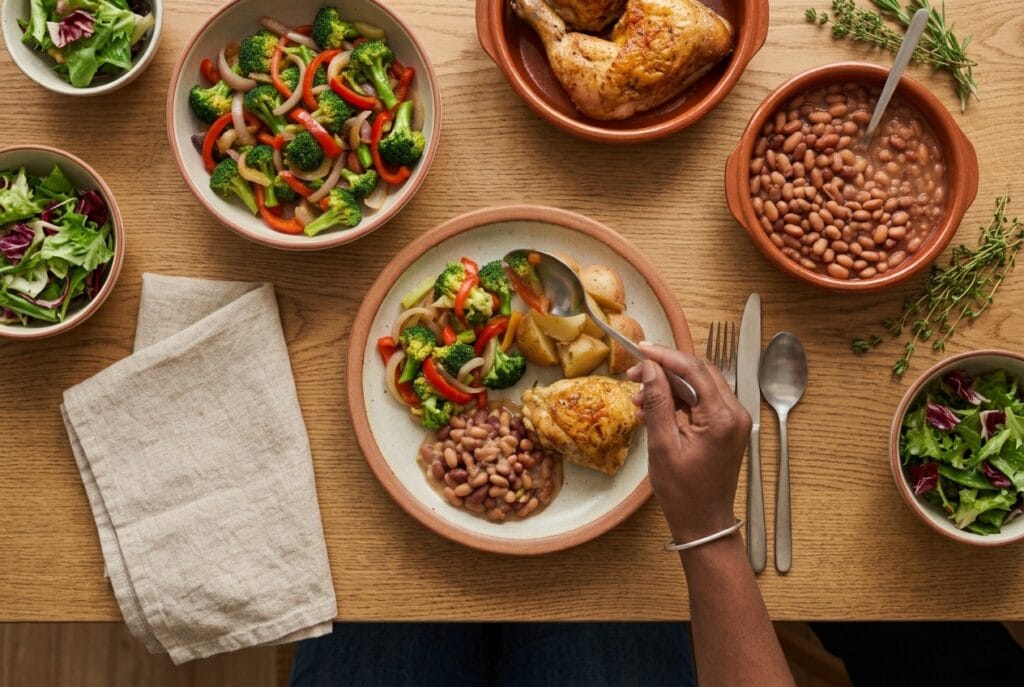
Depending on your preferences and individual needs, an everyday meal could include:
- vegetables or salad
- a suitable protein source
- a carbohydrate food
- a source of dietary fat
- water or another suitable drink
For a South African supper, that might look like chicken with vegetables and pap, beans with rice and salad, fish with potatoes and vegetables, or another familiar combination that works for your household.
Balanced eating does not require removing pap, bread, rice, potatoes or other foods you enjoy.
The overall pattern matters more than labelling individual foods as good or bad.
When people are working towards healthy weight goals, improving meal balance can sometimes be more practical than constantly trying to make portions smaller.
7 Practical Ways to Build Healthy Portions
You do not need to weigh every ingredient to become more aware of how much you eat.
These simple strategies can help make healthy portions easier to recognise in everyday life.
1. Put meals onto a plate or into a bowl
Eating directly from a large packet, takeaway container or serving dish can make it difficult to judge how much you have eaten.
Plating your food gives you a clearer view of your starting portion.
This is not about creating a perfect plate. It is simply a practical mindful eating habit that helps you notice quantity.
2. Look at the whole meal
Before deciding that your portion is “too big”, look at what is actually on the plate.
Could you add vegetables or salad?
Does the meal contain a suitable protein source?
Is most of the plate made up of one type of food?
Thinking about balance helps you work towards healthy portions without automatically cutting everything down.
3. Start with a comfortable amount
Serve an amount that seems appropriate rather than deliberately overfilling the plate.
Then eat and see how you feel.
If you are still physically hungry afterwards, you can have more.
Portion control for weight loss should not require you to ignore genuine hunger.
4. Notice your hunger cues
Your hunger cues can help you recognise when your body is asking for food.
You might notice an empty feeling in your stomach, reduced concentration, low energy or a growing interest in eating.
If you regularly wait until you are extremely hungry before meals, it may be harder to slow down and notice your portions.
Learning to recognise hunger cues earlier can form part of more consistent healthy eating habits.
5. Pay attention to fullness cues too
Your fullness cues can help you recognise when hunger has eased and you feel comfortably satisfied.
You do not need to wait until you feel uncomfortably full before stopping.
During a meal, occasionally ask yourself whether you are still physically hungry or whether you are simply continuing because food remains on the plate.
This type of mindful eating does not require analysing every bite. It is simply a way to reconnect with what your appetite is telling you.
6. Portion snacks rather than eating from large packets
You do not need to stop eating crisps, biscuits, nuts or other snacks simply because you have healthy weight goals.
Instead, putting a snack into a bowl or small container can make the amount more visible.
You can then enjoy it without repeatedly reaching into a large packet without noticing how much you have eaten.
7. Keep your approach flexible
Some days you will naturally feel hungrier than others.
A long workday, physical activity, changes in routine or what you ate earlier can all affect appetite.
Flexible healthy weight habits are usually more practical than expecting every meal and every portion to look exactly the same.
Hunger Cues, Fullness Cues and Mindful Eating
The idea of mindful eating can sometimes sound complicated, but it does not need to involve meditation or analysing every mouthful.
At its simplest, it means paying a little more attention to eating.
Before a meal, you might notice your hunger cues.
During the meal, you might notice how the food tastes and whether your hunger is easing.
Near the end, you might pay attention to your fullness cues and decide whether you want more.
For example:
Before eating:
How hungry am I right now?
Halfway through:
Am I still hungry, or am I starting to feel satisfied?
After eating:
Do I feel comfortably satisfied, still hungry or overly full?
You do not need to give yourself a score or get this “right”.
The purpose is simply to understand your eating patterns better.
For some people, appetite signals can be more difficult to interpret. People with a current or previous eating disorder or significant anxiety around food should seek guidance from an appropriately qualified healthcare professional rather than relying on general portion-control advice.
Portion Control at Braais, Restaurants and Takeaways
A useful approach to portion control for weight loss needs to work outside your kitchen too.
You should still be able to enjoy a braai, birthday meal, restaurant visit or takeaway.
At a braai, you could enjoy the foods you like while also looking at the overall balance of your plate. Perhaps there is meat or another protein option, salad, vegetables, pap, bread or potatoes.
There is no need to turn the occasion into a diet exercise.
When ordering takeaway food, remember that the restaurant decides how much goes into the container. That does not necessarily mean the entire container represents the right portion for you.

You might:
- choose a regular rather than automatically upsized meal
- eat slowly enough to notice your fullness cues
- save some food if you are satisfied before finishing
- add salad or vegetables at home
- share large side dishes if that suits you
- eat your chosen meal without feeling that you must compensate later
This is an example of balanced eating in real life.
The occasional larger meal is not something that needs to be “fixed”. Long-term healthy weight habits are built from your overall routine.
Common Portion Control Mistakes
Trying to eat as little as possible
Portion control should not become a competition to see how little food you can eat.
Very small meals may leave you unsatisfied, particularly if the meal is poorly balanced.
For sustainable weight loss, if weight loss is an appropriate goal for you, extreme restriction is not the aim. A routine needs to provide adequate nutrition and be realistic enough to maintain.
Ignoring hunger
Hunger is not a lack of willpower.
If you are genuinely hungry, repeatedly trying to ignore your hunger cues can make eating feel increasingly difficult.
Instead, look at whether your meals are balanced and substantial enough for your individual needs.
Cutting out familiar foods
Many people assume weight management means giving up bread, rice, pap, potatoes or other carbohydrate foods.
That is not automatically necessary.
These foods can be part of balanced eating, depending on the overall meal, your portions and your individual circumstances.
Focusing only on the main meal
Portion awareness includes more than the food in the middle of your plate.
Drinks, cooking oils, sauces, spreads and snacks are also part of your eating pattern.
This does not mean you need to measure everything. Becoming aware of these extras can simply give you a clearer view of your routine.
Expecting perfect portions every day
Your appetite and circumstances change.
One large family lunch does not undo your progress, just as one small salad does not create sustainable weight loss.
Consistency matters more than perfection.
A Practical Healthy Portion Checklist
If you want to improve your portion awareness, try these habits without changing everything at once:
- Plate meals rather than regularly eating directly from large packets.
- Include vegetables, salad or fruit regularly where practical.
- Include an appropriate protein source with main meals.
- Check your hunger cues before automatically serving more.
- Notice your fullness cues while eating.
- Look at your overall meal balance rather than simply making portions smaller.
- Keep familiar foods in your routine where they fit.
- Avoid skipping meals simply to compensate for eating more earlier.
- Review your eating habits across the whole week rather than judging one meal.
- Choose two or three healthy weight habits you can repeat consistently.
The objective is not perfection.
The objective is greater awareness.
Healthy Weight Goals Need More Than Portion Control
Portion control for weight loss is only one possible part of a broader lifestyle routine.
Healthy weight management may also involve:
- regular meals
- balanced eating
- everyday physical activity
- adequate sleep
- planning for busy days
- hydration
- stress management
- realistic routines
- consistent healthy eating habits
This is important because body weight is influenced by more than how much food appears on one plate.
It is also worth remembering that healthy weight goals can look different from person to person.
For one person, the focus may be changing meal structure. For another, it may be becoming more active, planning ahead or moving away from an all-or-nothing approach to food.
Sustainable weight loss, when weight loss is appropriate, is not about finding one trick. It is about creating a routine that can realistically continue.
When Portion Control Needs Individual Guidance
General portion advice is not appropriate for every person.
Speak to an appropriately qualified healthcare professional if you:
- have unexplained changes in body weight or appetite
- have a medical condition that affects nutrition
- are pregnant or breastfeeding
- have a current or previous eating disorder
- have received specific dietary instructions for a health condition
- are concerned about persistent changes in your hunger cues
- take medication that may affect appetite, digestion, blood glucose or body weight
Do not change prescribed medication based on general nutrition or weight-management advice.
A registered dietitian or other appropriately qualified healthcare professional can provide individual dietary assessment where needed.
How Everyday Wellness Can Help
Sometimes the challenge is not knowing that healthy portions, balanced meals and regular activity matter. The challenge is getting those habits to fit into workdays, family meals, weekends and changing routines.
Everyday Wellness provides general wellness support focused on practical habits, consistency and everyday routines.
Amanda can help you look at your current routine, discuss your healthy weight goals and identify areas where you would like more structure or accountability. This is general wellness support and does not replace medical or dietetic care.
If you would like a starting point, you can complete the Everyday Wellness assessment or begin with a free wellness chat.
Wellness note: Supplements and meal replacements are not automatically necessary for portion control or weight management. Whether any product fits into a person’s routine depends on their goals, preferences, overall diet and individual circumstances.
Frequently Asked Questions About Portion Control for Weight Loss
What are healthy portions for weight loss?
There is no single set of healthy portions that is right for everyone. Portion needs vary according to factors such as appetite, body size, activity, routine and overall diet. It is generally more useful to focus on balanced meals and appropriate portion sizes than to follow rigid universal rules.
Does portion control mean eating less at every meal?
No. Portion control for weight loss is better viewed as portion awareness. Sometimes you may need less food, while at other times your hunger cues may tell you that you need more.
Do I need to weigh my food?
Not necessarily. Some people find measurement useful, but many can improve portion awareness by plating meals, becoming familiar with their usual portion sizes and paying attention to hunger and satisfaction.
Can mindful eating help with portion control?
Mindful eating may help you notice when you are hungry, how quickly you are eating and when you begin feeling satisfied. It is not a weight-loss treatment or guarantee, but it can be a useful awareness tool for some people.
Can I still eat pap, rice and bread?
Yes. These foods can fit into balanced eating and healthy eating habits. Your overall meal, portions and broader dietary pattern are more important than automatically excluding individual foods.
Does portion control guarantee sustainable weight loss?
No. Sustainable weight loss cannot be guaranteed through portion control or any other single lifestyle strategy. Body weight is influenced by multiple factors, and individual outcomes vary.
Building Portion Awareness That Fits Everyday Life
Portion control for weight loss does not need to mean weighing every meal or following a long list of food rules.
Start with your normal routine.
Look at your portion sizes, build more balanced meals, notice your hunger cues and fullness cues, and make small changes that you can repeat.
Those everyday healthy weight habits are far more useful than trying to create a perfect plate at every meal.
The aim is not to eat as little as possible. It is to develop greater awareness, practise balanced eating and build a realistic approach to weight management that can fit into everyday life.